



Editor’s Note: Almost three years have passed since thousands of armed Gazans overran Israel’s border, murdered more than 1,200 Israelis, injured more than 5,000, and took 251 hostages. Amid the shock, horror, mourning, and retaliation, Israel also entered an excruciating period of trying to get their people home. An internal debate raged: What price was too high? Many pointed out that the terrorists released in 2011 in exchange for the soldier Gilad Schalit had included the masterminds and leaders who orchestrated the October 7 attacks. How should we weigh the lives of those held being held now against those who may suffer a similar fate in the future because of an agreement that sets them free?
In this heartfelt essay, Shivi Greenfield argues that there are moments when even a modern nation-state must abandon the calculus of realpolitik, times when the ultimate Jewish value of love overrides all—and that no price is too high when it comes to freeing our people. He explores the ancient halachic concept of pidyon shvuim, ransoming of captives, and especially the Jewish concept of love—which he develops more fully in his riveting new book, A Jewish Tale of Love: On Defiance, Meaning, and the Fate of a People, to be released later this week by Z3 and Wicked Son.
—David Hazony
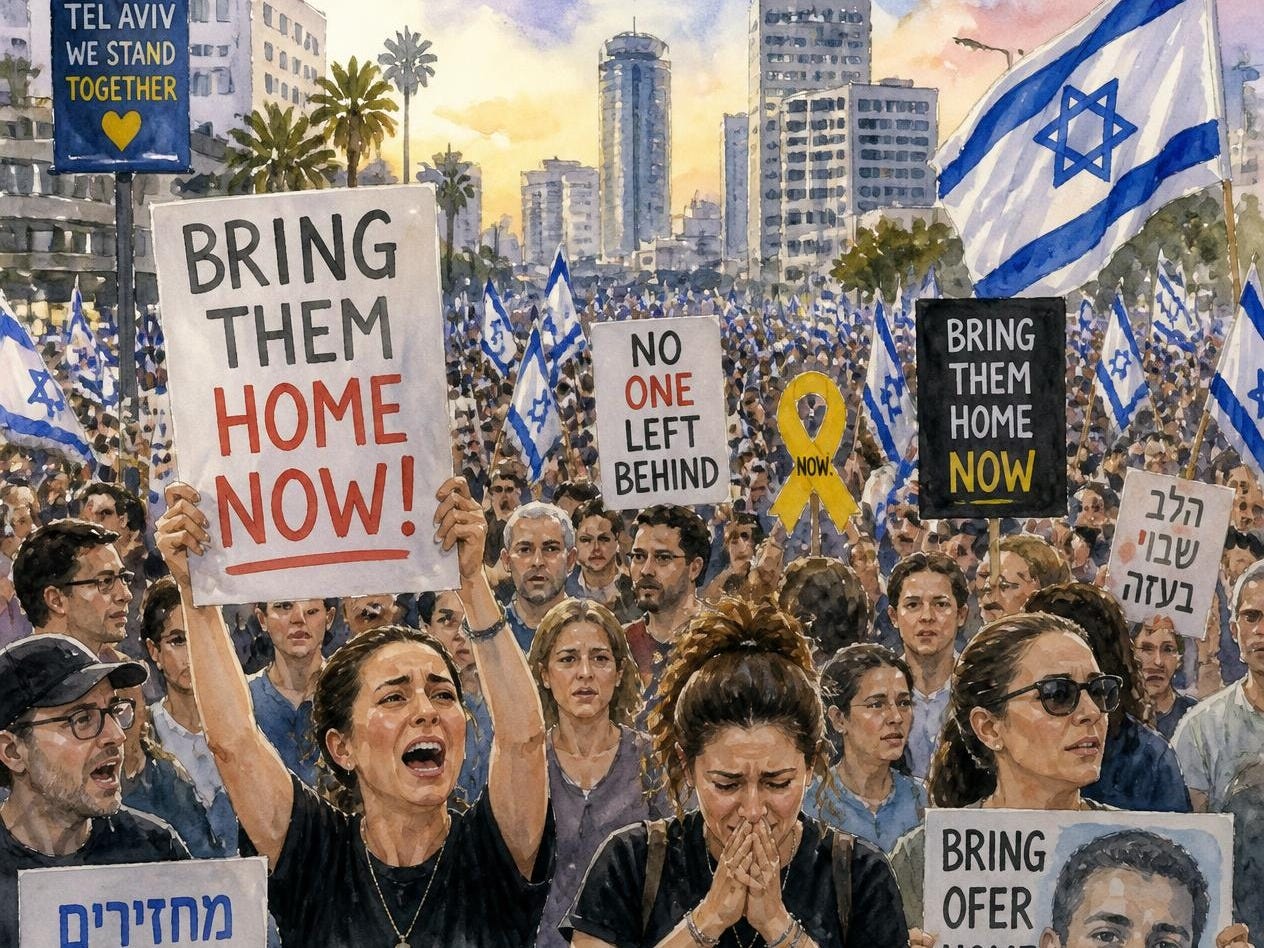
No Price Too High
Shivi Greenfield
Two thousand years ago, amidst the human wreckage of a Roman slave market, a sage named Rabbi Joshua ben Hananiah stopped short. Before him stood a Jewish child, fair of face and beautiful of eye, his feet chalked for sale on the auction block. The child was booty from a shattered Judea.
Joshua knew the law. In a ruling later included in the Mishna, the rabbis had explicitly taught that captives must not be redeemed for more than their accepted value, lest the whole nation become a target for endless abductions. Prudence, deterrence, and sober calculation all demanded inaction.
But Joshua did act. “I will not move from here,” he declared, “until I ransom him — no matter the price.” (Babylonian Talmud, Gittin 58a)
No matter the price. Those four words violate every rule of economics, every principle of deterrence, and every calculation of consequences.
This was not the eccentric statement of a single soft-hearted rabbi; it was an expression of a core value of an entire civilization. For while the Mishna would later rule in favor of limiting ransom to market value, in practice that rule would be ignored. Through history, Jewish communities would follow Rabbi Joshua’s example, paying many times market value to redeem captives.
This was the ultimate expression of what might be called “untamed love” — a radical, defiant devotion that bound Jews to one another over millennia.
This issue erupted again on October 7, 2023, when some 250 souls were dragged into the tunnels of Gaza by Hamas, and the Jewish state found itself locked in an agonizing moral dilemma. Over months of war, proposed hostage deals posed a harrowing set of questions: What would be the strategic cost of such a deal? Could that cost be justified? How many convicted terrorists would walk free? How many would return to murder? Did a lopsided exchange guarantee the next abduction?
These are rational, responsible questions of modern statecraft. But they run directly against the grain of the spirit that governed Jewish life for 2,000 years of exile — the code Rabbi Joshua voiced. The tradition he represented did not believe in “no price too high” due to accident or sentiment. It was built on an uncompromising foundation of Jewish love.
To understand why the hostage debate tore at the hearts of modern Israelis and Jews is to understand that we were not merely arguing over military strategy or cabinet policy. We were witnessing a profound reckoning with our tradition of untamed love.
***
When the Second Temple fell in 70 CE, the love that was once poured onto its altars was not consumed by the flames. It found a new dwelling place. Love was no longer directed toward a distant sanctuary; it was to be acted out in your relationship with the person standing before you. Writing in the early second century in the shadow of the Temple’s destruction, Rabbi Akiva taught that the entire Torah rests on a single verse — “love your neighbor as yourself” (Leviticus 19:18). Not the love of an abstract idea or virtue, but the love of every irreplaceable soul made b’tzelem elohim — in the image of God.
To be made in the divine image, the sages insisted, is not merely to share in something universal, but to be utterly singular. “God makes everyone in the same image,” the Mishna declares, “yet none is the same as another. Therefore, every person must say: for my sake the world was created” (Mishna, Sanhedrin 4:5).
In other words, no two souls are alike. Each is a unique reflection of the infinite. Because of this, lives are not interchangeable, no one is expendable, and the worth of one can never be measured against the worth of many. One life is equal to the whole world. The scales stay level because you cannot weigh the finite against the infinite and infinity itself cannot be measured or divided.
Lives are not interchangeable, no one is expendable, and the worth of one can never be measured against the worth of many.
Out of this radical metaphysical concept, the sages built the bedrock of Jewish law for the next two millennia. It was an uncompromising duty-based morality that refused to tally human lives like figures in a ledger. Its most haunting demonstration was the rule of ein dochin nefesh mipnei nefesh: “One soul is never set aside to save another” (Jerusalem Talmud, Terumot 8:4). This was the case even when a single sacrifice would buy the survival of many.
This was not abstract philosophy; it was concrete law. Fifteen hundred years before Immanuel Kant argued that a human being is always an end and never just a means, the sages established that human worth is beyond negotiation. To ensure no one mistook this conviction for mere sentiment, they subjected it to the most difficult possible test:
[In a case where] a group of people is seized, and their captors say to them: “Hand over one of you and we will kill him; if not, we will kill all of you.” The law is: Let them all be killed, and they may not hand over even a single soul. (Tosefta, Terumot 7:23; Jerusalem Talmud, Terumot 8:4)
In such a case, you are not asked to kill anyone. You need only surrender one, and the rest live. Yet the law still forbids it. To buy your survival with another’s body is to declare that some lives are worth more than others, which is forbidden by the uniqueness of each soul. There is no “greater good” that transforms a human being into an instrument.
This is the foundation of the argument now tearing at modern Jewish life. It is one of the oldest disputes in moral philosophy: Are right and wrong determined by obligations that remain absolute regardless of the consequences? Or by an evaluation of precisely those consequences? The tradition of the infinite soul stands upon the former principle. It refuses to price what is priceless.
***
From the concept of the infinite worth of the single soul, the sages drew the fundamental conclusion that kol yisrael arevim zeh bazeh — all Jews are responsible for one another (Babylonian Talmud, Shevuot 39a). They are not responsible for one another in the soft sense of well-wishing concern. Rather, they are bound as a single body, sharing one fate.
In the second century, Rabbi Shimon bar Yochai illustrated this with the story of a group of people sitting in a boat. One man begins to drill a hole beneath his own seat. “It is my seat,” he insists, “my own affair.” The others cry out — “You will drown us all!” (Leviticus Rabbah 4:6).
Thus, there are no private affairs. The water that takes one takes everyone.
In this, the metaphysical claim and the communal vow become a single conviction: The infinite worth of the individual is the foundation, which in turn demands the unconditional bond of arevut. A guarantor does not trade away the very life he has pledged to protect. “No one gets left behind” is not a modern idea; it is an imperative that follows directly from the idea of a single life as a world entire.
***
These twin principles met in the concept of pidyon shvuyim — the redemption of captives: It was arevut in action and love with a price tag it refused to read. Jewish law refused to treat ransoming captives as standard charity; instead, it elevated it above nearly every other obligation.
Maimonides, who personally led ransom campaigns in 12th-century Egypt, called the redemption of captives the greatest of all commandments because the captive stands in mortal danger, and thus to turn away from them is to violate the Torah in every way (Mishneh Torah, Matnot Aniyim 8:10). Rabbi Yosef Karo, whose 16th-century code still governs observant life, was blunter: to delay ransoming a captive you could have freed “is as if you shed blood” (Shulchan Arukh, Yoreh De’ah 252:3). To leave a Jew in captivity was not a failure of generosity; it was murder.
In the direst circumstances, across centuries of exile, Jewish communities lived up to this mandate at the highest imaginable cost. When Fatimid-sponsored corsairs sold Jewish captives in the slave markets of 11th-century Alexandria at 33 gold dinars a head, the local community emptied its charity funds, stripped the silver from its Torah scrolls, and — on the brink of bankruptcy — begged distant congregations along the Nile to help shoulder the debt.
When the First Crusade turned Jerusalem into a slaughterhouse in 1099, exilic networks from the Maghreb to Spain pooled their gold to buy back survivors they had never met.
Centuries later, the Jews of Venice, penned behind the iron gates of Europe’s first ghetto, funded a standing account to ransom their brethren from the slave pens of Malta.
In every empire, the same thing happened: a Jew was in the dark, the call went out, the ransom was gathered, and no expense was spared.
The economics were suicidal, and everyone knew it. A predatory market grew up around this love, because captors understood that the Jews would always pay. Still, the Jews paid.
This is the edifice built by tradition: the infinite worth of the person, the unconditional bond it creates, and redemption at any cost it demands. Rabbi Joshua ben Hananiah, refusing to move at the Roman slave market, was standing on all three principles.
Nonetheless, the objection that the modern State of Israel raises against this principle of unlimited payment deserves to be disputed in good faith, because the objection also speaks in the language of tradition.
***
When the Jewish state agonizes over releasing terrorists or hesitates to agree to a lopsided deal, it is not motivated by realpolitik alone. It is standing on a principle as ancient as Rabbi Joshua’s refusal. This is Judaism arguing honestly with itself.
For example, the Mishna rules that captives may not be redeemed for more than their market value mipnei tikkun olam—for the good order of the world. (Mishna, Gittin 4:1)
The sages understood that excessive ransom was a trap: If Jews would pay anything, every Jew would become a prize, and excessive love for the captive could seed the abduction of ten more. This is the exact argument raised in contemporary debates: that a lopsided deal ransoms today’s captives with tomorrow’s captives. The Mishna’s restriction is not a failure of Jewish compassion; it is Jewish compassion doing arithmetic.
When the Jewish state agonizes over releasing terrorists or hesitates to agree to a lopsided deal, it is not motivated by realpolitik alone.
Tradition even offers a saint for the pro-arithmetic side. When imperial captors held Rabbi Meir of Rothenburg in the late thirteenth-century for a ruinous ransom, his disciples raised the sum at once. Rabbi Meir forbade them to pay it, invoking the warning that ransoming him would only invite the next abduction. He chose to waste away and die in the fortress of Ensisheim rather than teach his captors that a great rabbi could be turned into a fortune. This was a leader who looked at the ledger of future consequences and gave his life to it.
So, if the tradition itself knew that untamed love could break a community, perhaps Israelis and Jews who worry about the strategic cost of redeeming today’s hostages are the true heirs of the Mishna and Rabbi Meir?
Perhaps, but we must examine what Jewish history actually did with the Mishna’s ruling.
***
The sages set the pattern from the very start. Standing in the Roman slave market — in the very situation the Mishnaic restriction on ransom were intended to address — Rabbi Joshua ben Hananiah looked at the restriction, brushed it aside, and paid.
When Maimonides led his ransom campaigns in 12th-century Egypt, and when the Jews of Alexandria, Jerusalem, and Venice stripped their synagogues to buy back captives at extortionate prices, they were not ignorant of the Mishna’s warning. They knew the restriction existed. Yet across two millennia, codifier after codifier ruled that when an individual life stands in immediate, mortal danger, the abstract risk of future abductions cannot prevail. The living halacha treated the Mishnaic restriction not as an absolute bar, but as a narrow guideline regularly set aside in the face of actual human suffering.
What of Rabbi Meir of Rothenburg, the saint of the pro-arithmetic side? Tradition preserved his story precisely because it was an astonishing anomaly. His example was honored because his restraint was so extraordinarily rare that it proved the rule. The living halacha remained what it had always been: You paid.
This is the answer to the honest objection: The tradition did not lack an arithmetic option. It certainly did, and it was backed by the highest authority. Yet Jewish communities, overwhelmingly, chose to ignore it; not because they were blind to the strategic cost, but because they had decided, at the root of their collective being, that some things are priceless.
The restriction was real. Love overrode it. That override was the living tradition. Real-world Judaism was never the Mishna’s ledger. It was Rabbi Joshua refusing to move.
***
Now the sharpest objection arises, the one every honest reader has already thought of: The Jewish communities of exile could be absolutists. They had no army, no borders, no sovereign duty to protect an entire population from future slaughter. Sovereignty, on the other hand, involves the hard law of consequences. A responsible state cannot prioritize the few over an entire population. In a world of realpolitik, calculation is not a moral failure; it is the price of staying alive.
Today, that calculation is no longer measured in silver. Ransom is paid in the release of convicted murderers. Among the architects of October 7 was Yahya Sinwar, freed in the 2011 exchange that brought home a single captive soldier, Gilad Shalit, in return for more than a thousand terrorist prisoners. We ransomed one of our own, and the price we paid walked free to engineer the murder of 1,200 and the abduction of 250 more. Is it not itself a form of protective love—a duty to the unborn and the un-taken—to refuse a bargain like that?
We should not flinch from the implications of this. Sinwar was not an abstraction; the people he murdered and kidnapped are real. We must grant the objection its full and dreadful strength by assuming every ransom involves the release of a future killer.
Even then, the tradition’s verdict does not change and understanding why is essential.
The realist claims that exilic solidarity was a luxury of the powerless. This inverts history entirely. It imagines that “untamed love” was cheap, when it was actually the most expensive commitment a stateless people ever made. To announce to predatory empires that you would ransom every captive at any price was nearly suicidal—and the Jews held to it anyway. The irony is not that they survived despite this ethic; it is that without it, they would never have survived at all.

Picture a scattered people that ran the numbers coolly, categorized its captives, and wrote off those who cost too much. Such a people would have made a perfectly reasonable decision—and that people would have dissolved. What held the Jews together across 2,000 years of exile was not a state apparatus, but a bond: the absolute conviction that not one of us is expendable.
Sovereignty was meant to add an outer wall of physical power around that ancient inner bond, never to become the excuse for pulling the inner wall down. To use state strength to become more willing to abandon captives than ever was a powerless ghetto is not strategic maturity; it is to mistake a load-bearing wall for a decoration.
This is precisely why, even though the tradition knew the math of future danger and wrote that math into mipnei tikkun olam, a hundred generations refused to live by it. This was not because they were blind to the arithmetic, but because they held to standards beyond arithmetic.
A people that judges which of its children are too expensive to save has already begun to dissolve the covenant that makes its survival worth defending. It may come out ahead on the security ledger, but it will lose the soul that made it a people. That is the ultimate test of the Jewish state: whether sovereign power was reclaimed to shield the covenant or to replace it.
***
There is one last twist to the tradition. It is the one I find hardest to shake, because it shows that the sages anticipated our dilemma and our temptation and warned against both in the strongest possible words.
The sages forbade trading soul for soul, but they allowed a single, narrow exception: If a hostile mob demands a specific, named individual who is already guilty of a capital crime (chayav mitah), the community may surrender him to save itself. (Tosefta, Terumot 7:23; Jerusalem Talmud, Terumot 8:4)
Here, at last, seems to be legal permission to do the math. But apply it to the hostages in the tunnels of Gaza and it disappears: They were seized at random and were wholly innocent. The one exception tradition allowed is irrelevant.
Moreover, having granted the exception, the sages refused to let anyone use it.
The Talmud tells of Ulla bar Koshev, a third-century Judean rebel charged with capital crimes, who hid in the city of Lydda. The Romans surrounded the town with a terrifying ultimatum: Hand him over, or we will destroy you all. Every condition of the legal exception was met. Ulla was a specific, named man whose life was already forfeit.
So, taking the weight of the city on his shoulders, the local sage, Rabbi Joshua ben Levi, made the agonizing choice to save the town. The difficulty of the decision is shown by the fact that the rabbi sought to minimize his role in the betrayal: Rather than hand Ulla over directly, he privately persuaded the rebel to surrender of his own accord. Thus, according to the strict letter of the law, the sage had not only fulfilled his duty but used the utmost restraint in doing so.
Yet, despite every justification, the heavenly response was merciless.
Rabbi Joshua ben Levi had been accustomed all his life to mystical visits from the prophet Elijah, who came daily to study with him. From the day Ulla surrendered, Elijah stopped coming. The sage fasted 30 days in grief until, at last, the prophet returned. “Why did you abandon me?” the sage asked. Elijah answered with one of the most devastating lines in rabbinic literature: “Am I a companion to informers?”
“But I acted according to the law,” the sage protested.
Elijah replied, “And is this the way of the pious—hilchot chasidim?” (Jerusalem Talmud, Terumot 8:4)
The sage kept to the letter of the law, but the Divine Presence withdrew anyway. Even regarding a named, guilty man; even after going out of his way to soften his own involvement, the sage failed the test. Hilchot chasidim describes a standard above formal duty; the standard of those who love more than the law can compel. Its message is uncompromising: There is a kind of moral accounting that is entirely legal, but spiritually fatal. You can be wholly within your rights and still drive holiness out of the room. As Maimonides later codified: The law permits it, but we do not instruct anyone to do it. (Mishneh Torah, Foundations of the Torah 5:5)
Now we must look at ourselves in the mirror: If the Divine Presence abandoned a righteous sage who acted under explicit legal license to surrender a named, guilty rebel, and who even went out of his way to minimize his own role by persuading the man to yield himself up on his own, what does this say of a sovereign people that debated, coolly and at length, whether to abandon its innocent children to the dark, and called that debate maturity?
We didn’t even stay within the exception. We went beyond it, into an arithmetic that tradition itself never legitimized. The Israeli government argued from the point of view of statecraft. The crowds in the square, weeping for children who were not theirs, channeled a love that comes before any calculation. The withdrawal of Elijah is what it looks like when a people talks itself out of love in the name of responsibility.
***
Let us return, one last time, to the Roman slave market. Rabbi Joshua ben Hananiah stands before a child he has never met, refusing to let the arithmetic win. He is not naïve; he knows the danger as well as anyone alive. He simply loves this Jewish child—this world entire—more than he fears the cost.
In that refusal lies the secret of how a hunted people outlived every empire that tried to erase it. The Jews survived across 2,000 years of exile not because they were good at math, but because they loved in a way that placed the single soul beyond the reach of such calculations. When the captor said, “hand over one and save the rest,” they answered, against all reason, “no.” To lose one is to lose a world; to save one is to save a world.
Our generation faces that same test. Today, the threat is not the sword but the spreadsheet, not open persecution but strategic prudence. The October 7 hostages were never the whole story; they were simply where the choice became impossible to ignore.
The same test awaits wherever Jews live. It awaits anyone who weighs whether the inheritance is worth its cost; who treats belonging as a line item rather than a bond beyond price. In Israel, it takes its starkest form in the need to decide, under fire, whether Israel is a people organized around the infinite worth of each of its own or merely the stage on which Jews happen to stand. But the homeland only underlines what the Diaspora faces: Whether, with no enemy at the gate, we still choose one another when nothing forces us to.
Statecraft is real and consequences are real. This essay does not pretend to dictate the terms of any deal or to judge those who have wrestled honestly with an impossible dilemma. But we must name what the wrestling revealed: This was never, at the end of the day, about the hostages alone. It was about the fundamental question asked wherever Jews still wonder what they are to one another. Do we still carry the fierce, defiant love that made us a people, or have we quietly agreed to live without it?
Almost three years on, that question is still ours to answer. In the end, as it always has, everything depends on how we choose to love.
Shivi Greenfield, Ph.D., is an adjunct fellow at the Z3 Institute for Jewish Priorities, and author of A Jewish Tale of Love: On Defiance, Meaning, and the Fate of a People (Wicked Son/Z3, 2026), as well as Judaism and Liberalism (Yediot, 2022). Translations of classical and rabbinic sources are the author’s own.
A question with a dilemma: Do you stand for a Jew that will not stand for Israel and, by extension, will not stand for fellow Jews? How do you handle the saving of a Jew that stands in the streets demonstrating for a free "Palestine"? Do you save such a Jew who has abandoned his (her) own people? Personally, I would not raise my rifle to save such a "good Jew". I would leave his (her) life up to the judgement of G-d.
A vigilant defense would have thwarted the attack, and our continued war (even if justified) just creates new sinwars every day. There will ALWAYS be sinwars and we continue to enable them, the issue isn’t the sinwars.