



Editor’s Note: In a recent essay in the Jewish Journal, Z3 Project director Amitai Fraiman called for the creation of a “new Borscht Belt”—cultural settings where Jews could hone their craft, and thereby preserve both their role in greater society and their sense of communal coherence. Indeed, it’s already begun: Faced with exclusion from major cultural industries, Jews have begun building alternative institutions—publishing houses like Wicked Son, Canary, and High Line, as well as parallel structures for film and and other areas.
These are crucial for rebuilding the Jewish arts in an era of discrimination, but they don’t fix the larger problem, writes Z3 Institute senior fellow Izabella Tabarovsky in this month’s essay. Revisiting the PEN America controversy that erupted this past July, Tabarovsky reminds us of the crisis of truth currently facing Western society—of which antisemitism is only a symptom. Indeed, repeated scandals in some of the central repositories of Western thinking—think of the Jason Arday case and its implications for universities like Cambridge and publishers like Simon & Schuster—raise questions that go far beyond the fate of Jews in the West. “Today, the Jewish struggle against epistemic antisemitism has become part of a broader struggle for factual truth,” she concludes. “Renewing our society’s commitment to truth may be one of the most important Jewish and democratic tasks of our time.”
—David Hazony
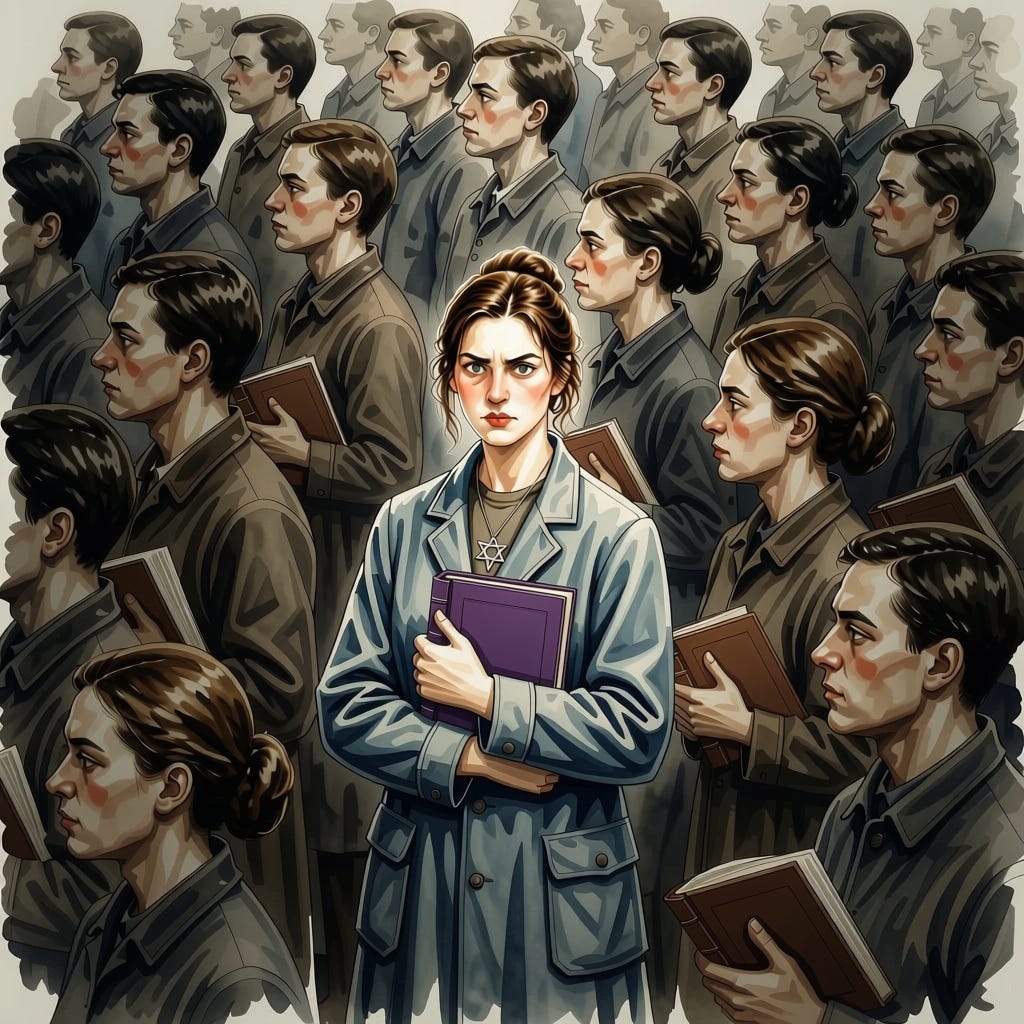
PEN America and the Crisis of Truth
Izabella Tabarovsky
The recent uproar over the PEN America article “A Silent Moratorium,” which documented discrimination against Jewish and Israeli writers in the publishing industry, seems to have died down. It may be tempting to write it off as a tempest in a teacup, affecting a tiny group of people in a shrinking industry with an inflated sense of self-importance. But that would be a mistake.
The controversy surrounding the piece shone a spotlight on two trends that have been rapidly consolidating in recent months. One is to increasingly treat Jewish first-person testimony about antisemitism as false, enraging, or irrelevant. The other is to increasingly accept as a given that facts are subordinate to preferred ideological narratives and intended political outcomes.
The two trends have consequences far beyond the PEN controversy. The first represents the next stage in the dehumanization of Jews, relegating them to second-class citizens deprived of the right to speak on their own behalf. The second—which is deeply intertwined with the first—threatens something all of us depend on: the ability to establish what happened, what’s real, and what’s true.
Together, these trends point to something even more troubling: an abandonment of truth as one of the fundamental principles on which society rests. Humanity’s moral and spiritual traditions have long treated the pursuit of truth as inseparable from the pursuit of justice and as a virtue in itself. What happens when we stop?
***
Based on interviews with some thirty American Jewish and Israeli fiction writers, “A Silent Moratorium” described “a widening cultural isolation,” “rising hostility,” and “silencing” that the group has experienced since Hamas’s October 7, 2023 attack on Israel.
Some writers talked about “event disinvitations and cancellations,” online harassment, organized negative reviews, and “new and growing barriers to publication.” Others were told that “this wasn’t the right time for Jewish books” and asked “to remove Jewish characters and references to Israel from their novels.” One was advised to stop writing about antisemitism, because Jewish victimhood was out of fashion.
In one particularly grotesque example, the literary quarterly Guernica retracted an essay about an Israeli author’s experience of driving Palestinian children to receive medical treatment. The reason? Several staff resigned in protest of its publication, with one declaring the essay an attempt “to soften the violence of colonialism and genocide.”
“We have essentially been hounded out of literary life,” one writer testified.
In response, the great and the good threw a temper tantrum. Staffers at PEN America reached out to its president Dinaw Mengestu, upset that they hadn’t been warned the piece was coming. Mengestu resigned the same day—but not because he was ashamed of his organization’s failure to safeguard Jewish literary expression. What worried him, he told the New York Times, was that the article’s criticism of anti-Israel boycotts might limit the boycotters’ own free expression.
It takes particular mental gymnastics for the head of a free-speech organization to suggest that the rights of the silenced are subordinate to the rights of those seeking to silence them—or to suggest, as he did, that opposing cultural boycotts was “unethical.” Mengestu’s other explanations for his abrupt resignation were even less persuasive.
For those who have followed recent developments, Jewish writers’ testimonies in the PEN America piece were hardly a surprise. As far back as 2021, journalist Melissa Braunstein reported similar experiences in a piece titled “Publishers Against the People of the Book.” Evidence of discrimination against Jews in publishing has been snowballing ever since, with writer Meg Keene recently offering quantitative evidence that fiction deals mentioning Jews, Judaism, or Israel have been on the decline for years.
Which raises the question: What was really behind the fit the piece caused?
One didn’t have to be a trained intelligence analyst to land on an explanation.
The testimonies documented in “A Silent Moratorium” ran counter to two dogmas that now rule our cultural landscape. One holds that acknowledging Jews as victims is a big no-no, lest it dilute the purity of Palestinian victimhood—and the corresponding purity of Jewish villainy.
Second, and arguably worse, the writers’ testimony gave lie to the dogma that “anti-Zionism” is not and can never be antisemitic. Interviewees repeatedly described acts of anti-Jewish discrimination accompanied by “anti-Zionist” language, undermining the reigning narrative and exposing the bien-pensents as ordinary bigots in the process.
All this came to light in a Facebook post on the controversy by M. Gessen, a Pulitzer Prize-winning New York Times columnist. It’s worth examining the post and the subsequent exchange to fully understand the logic of the uproar—and its dark implications.
***
A week after the publication of “A Silent Moratorium,” Gessen decided to chime in by attacking the credibility of the article as a whole. “The writing, the research, and the argument are just so bad. To call it misleading would be an understatement,” Gessen posted. Having dismissed one of the article’s examples as an easily explainable exception, Gessen noted that the Israeli novelist Etgar Keret was still getting published, and that it was Palestinian and pro-Palestinian writers who were, in fact, getting canceled. The message was clear: not only were the experiences of the 30-plus Jewish writers eclipsed by the suffering of Palestinian writers—they were not even to be believed.
In the comments section, Mikhal Dekel, author of Tehran Children, pushed back. The picture, she wrote, was more complicated, particularly for less famous Israeli writers whose work didn’t fit neatly into ideological boxes and instead explored the complexities of Israeli society such as their own grief or real-life Israeli-Palestinian relationships.
It takes particular mental gymnastics for the head of a free-speech organization to suggest that the rights of the silenced are subordinate to the rights of those seeking to silence them.
Gessen’s response was notable. Having initially attacked the article’s evidence of exclusion, Gessen now turned to explaining why such exclusion was justified. Even if some Israeli writers were being treated unfairly, it was “disingenuous and plain dumb” to characterize their treatment as censorship or antisemitism. Israeli writers, Gessen argued, bore responsibility for their government’s actions: “What are the responsibilities of a writer who happens to be a citizen of a state that’s waging a genocidal war? Is it fair to ask a writer to take a position on their country’s actions? Is it fair to deny them the right to keep writing about their society as though the genocide weren’t happening?”
Gessen’s answer to these questions was yes, it’s fair. Now was not the time for literature that explored the complexity of Israeli lives—“not while the genocide is continuing and while the majority of people with those complex predicaments support it and tolerate it.” To illustrate the point, Gessen drew parallels with Russian writers after the invasion of Ukraine and invoked Heinrich Böll, asking readers to imagine Böll’s novels about ordinary Germans being published while he was still serving in the Wehrmacht. Now was a time “for laying down basic moral coordinates,” Gessen decreed. “The time when readers outside of Israel are ready to start filling in the many shades and colors of the grid will come later.”
***
There is something revealing about Gessen, who grew up in the USSR and has long cultivated a reputation as an anti-authoritarian, arguing that literature and readers’ exposure to it should be subordinated to political and ideological imperatives.
Gessen’s justification for this blatantly illiberal position is the conviction that Israel is committing genocide: that’s what provides the “moral coordinates” that supposedly justify the exclusion of Israeli writers from public conversation.
One obvious problem with this argument is the mountain of evidence contradicting the genocide accusation. Countless historians, military experts, and legal scholars have argued that applying the term “genocide” to Israel’s war against Hamas is simply wrong. Data analysts, statisticians, epidemiologists, public-health, food, and nutrition experts have produced one report after another making the claim irreconcilable with facts. The most generous way to characterize the accusation is that it remains unproven, and public debate about it—unsettled.
But even if the charge of genocide were ultimately proven true, Gessen’s argument would still require embracing a radically illiberal position. Liberal societies don’t appoint arbiters, whether they are critics, journalists, or cultural bureaucrats, to assign the “right” time for certain books to appear, or to decree in advance which literature readers should have access to, and when.
In a free society, literature appears in real time alongside political argument, journalism, scholarship, and protest, trusting readers—and future generations—to make sense of the complex questions facing us at the moment when they matter most.
***
Which brings us to the question of truth.
By allowing an unproven and heavily contested accusation of genocide to override well-documented, first-hand testimony of discrimination against Jewish writers, Gessen illustrates a broader phenomenon: the delegitimization of Jewish testimony about the discrimination they experience as Jews.
Israeli legal scholar Cochav Elkayam-Levy calls this phenomenon “epistemic antisemitism.” Elkayam-Levy led the effort to document Hamas’s crimes of sexual violence committed during the October 7 massacre and against Israeli hostages held in Gaza, a position that got her a front-row seat to the harrowing campaign of denial that followed.
Speaking at a recent conference on contemporary antisemitism at the University of Haifa, she said that on October 7 “we were confronted not only with atrocity but also with a crisis of perception.” The atrocity and its denial “emerged in an instant,” unfolding together and destabilizing people’s ability to grasp what’s true. She referred to this phenomenon as “a crisis of truth.”
In the following months, Elkayam-Levy watched Jewish victims face evidentiary demands that would “rarely be expected elsewhere in the world.” With denials growing increasingly “sophisticated,” she and her colleagues realized that the central question was no longer whether there was sufficient evidence to prove the fact of sexual violence. The central question was “whether Jewish and Israeli testimony could acquire legitimacy in the first place.”
It was this experience that led Elkayam-Levy to conclude that antisemitism operates not only at the level of physical threats and hostility but also “epistemically”—at the level of perception. And this notion shows exactly why the scandal that erupted around the PEN America article has implications beyond narrow literary circles.
By depriving Jews of authority as witnesses to their own lived experiences, epistemic antisemitism undermines their ability to defend themselves and to secure understanding, solidarity, and ultimately justice. Today it is an influential New York Times columnist and Pulitzer Prize-winner dismissing Jewish writers’ testimony about censorship. Tomorrow, it may be the head of an HR department dismissing a workplace discrimination complaint filed by a Jewish employee because she has been conditioned to believe that Jews inflate accusations of antisemitism for political or professional gain. The next day, it may be a judge quietly deciding that a Jew or an Israeli is generally a less credible witness because of their ethnic and national origins.
One doesn’t have to hate Jews to participate in and reinforce this environment. One only has to believe the lie.
And the damage doesn’t stop with Jews. Epistemic antisemitism, Elkayam-Levy argues, creates instability “around truth itself.” It affects “the conditions under which knowledge is produced, circulated, and believed”: “what can be said, what can be accepted as credible, what cannot be believed, whose victimhood is accepted or denied, and which narratives are preserved.” Once those conditions become corrupted by ideology, a shared factual reality becomes impossible.
***
In her seminal 1967 essay Truth and Politics, Hannah Arendt argued that no political community can exist without a shared commitment to factual truth. Facts about its past are central to creating a shared political reality. When such facts are denied, distorted, or thrown into doubt, a community loses the solid ground from which to understand its present and build its future. Freedom of opinion itself becomes a farce “unless factual information is guaranteed and the facts themselves are not in dispute.”
Because factual truth is “established by witnesses and depends upon testimony,” it is particularly vulnerable to manipulation by political power. The past itself cannot be changed, but our knowledge of it can be twisted, erased, and suppressed. Once those factual records are lost, Arendt writes, “no rational effort will ever bring them back.”
By depriving Jews of authority as witnesses to their own lived experiences, epistemic antisemitism undermines their ability to defend themselves and to secure understanding, solidarity, and ultimately justice.
With breathtaking contemporary relevance, Arendt notes that organized lies “harbor an element of violence,” ultimately seeking to destroy what they negate. Recalling Stalin’s erasure of Trotsky from Soviet history, she remarked dryly that when Trotsky discovered that he had supposedly played no role in the Russian Revolution, “he must have known that his death warrant had been signed.” Erased from history, he was soon “eliminated from the world of the living.”
That blood-curdling example has unsettling relevance to what millions of Jews around the globe are experiencing today. No other group has been as relentlessly lied about, demonized, and defamed as the Jewish community. After October 7, Jews experienced first-hand what Arendt describes as “rewriting contemporary history under the eyes of those who witnessed it.” The denial and erasure of Hamas’s atrocities, whose organized nature is increasingly evident, have been accompanied by both a campaign of lies about Jews and a surge in violent antisemitism.
The ripple effects of this organized campaign of lies can spread far beyond its immediate target. Once enough people believe that Jews have committed genocide in Gaza and take it as a given that Jews exaggerate, fabricate, or weaponize accusations of antisemitism, these ideas shape the shared culture, leading people to discount Jewish testimony even when they believe themselves to be acting in good faith.
The real-life danger inherent in that dynamic is obvious. Its devastating potential was illustrated in Australia, where Jews repeatedly warned about the consequences of unverified reporting and reckless opinionating with regard to Israel’s actions in Gaza, as well as the true meaning behind substituting the word “Zionist” for “Jew.” Their warnings were largely ignored—until the Bondi Beach massacre claimed the lives of 16 and injured 41. It became a tragic illustration of both dangers at once: Arendt’s warnings about the relationship between lies and violence and Elkayam-Levy’s about epistemic antisemitism.
The attempt to discredit the testimony of Jewish writers by members of America’s cultural elites contains elements of the same disturbing pattern.
But there is also a paradox at the heart of Arendt’s article, which suggests a way forward.
To be sure, the factual record is fragile. But reality itself is not. Facts have one enormous advantage over those who falsify them: what happened, happened. Arendt calls this their stubborn “thereness.” History didn’t have to unfold the way it did, but once it did, its facts became irreversible—and indifferent to whose political purposes they serve.
This gives reality a decisive advantage over those who falsify it. Every new fact that emerges forces the liar to revise the lie. Every new witness requires another explanation. Every image requires a new story. Every document demands another excuse. The lie grows increasingly elaborate. The liar begins, in Arendt’s words, to drift “from one possibility to the next.” Reality doesn’t have that problem. Which is why facts ultimately prove “superior to power.”
But the factual record still has to be preserved. Defending that record against attempts to erase, distort, or discredit it becomes an act of resistance.
***
At the conference in Haifa, Elkayam-Levy offered a term for this. The answer to epistemic antisemitism, she said, is “epistemic resistance.” For her, the very work of documenting the October 7 atrocities became “part of the intervention, part of justice, part of combatting antisemitism and antisemitic narratives.”
It is a powerful framing, which recalls a central insight of the 20th-century anti-totalitarian movements: when a system is built on lies, defending reality becomes a political act. The first act of rebellion by Winston, the protagonist of Orwell’s 1984, is to refuse to surrender his own grasp of reality and truth. “Freedom is the freedom to say that two plus two make four. If that is granted, all else follows,” he writes in his secret diary. He clings to memory, reminding himself that “the solid world exists, its laws do not change.” Even when outwardly conforming to the Party, he refuses internally to accept its logic and language.
Elkayam-Levy taps into the same intuition. Most important, anyone who believes that a good-faith search for truth is essential to a healthy society can take part in it.
What does epistemic resistance look like today? It may mean building new institutions to preserve and produce knowledge. It may mean developing new intellectual frameworks.
After October 7, Elkayam-Levy and her colleagues discovered that existing legal concepts were inadequate to describe the atrocities they were documenting and had to create entirely new categories. They also couldn’t rely on conventional methods of preserving the evidence underlying their report, Silenced No More, and had to build a secure digital archive to safeguard it.
Meg Keene, the author who quantified discrimination in publishing, proposed reimagining Jewish publishing “as an act of peoplehood.” If Jewish stories aren’t published, then “part of the Jewish record goes missing,” she wrote, calling the problem existential. Jews don’t wait until history is over: “We write while the dust is still in our mouths.” Keene is now helping build such an alternative: she was recently appointed to lead the newly launched literary division of Wicked Son Books, which up to now has focused on Jewish non-fiction.
Across the country and globally, Jews and non-Jews are launching new publications, creating new journalism prizes, founding new organizations and movements, developing new curricula, and establishing new academic institutions or revamping old ones.
Having lived through the Soviet authoritarian regime, I’ve learned that the longing for truth is ultimately as powerful as the longing for justice. Conventional wisdom built on lies has a limited shelf life, and institutions built on falsehood eventually lose their authority. Today, the Jewish struggle against epistemic antisemitism has become part of a broader struggle for factual truth. Renewing our society’s commitment to truth may be one of the most important Jewish and democratic tasks of our time.
Izabella Tabarovsky is a Senior Fellow at the Z3 Institute and the author of Be a Refusenik: A Jewish Student’s Survival Guide (Wicked Son and Z3, 2025). She is also a fellow at the Woodrow Wilson International Center for Scholars and at the London Centre for the Study of Contemporary Antisemitism and Comper Center for the Study of Antisemitism and Racism, University of Haifa. A contributing writer at Tablet, she has also published in Newsweek, Sapir, Quillette, and Fathom. She has appeared on the Haviv Rettig Gur’s Ask Haviv podcast, Wondering Jews with Noam Weissman and Mijal Bitton and the Karol Markowicz Show, among others. Her essays appear in multiple edited volumes published by Routledge, Academic Studies Press and others. Her work has been translated into numerous languages.
Tickets Available: Z3 Conference 2026
The Z3 Conference is returning to Palo Alto on November 1, 2026. I’ll be there as well as many of the writers and scholars associated with the Z3 Institute. Tickets are on sale now!
